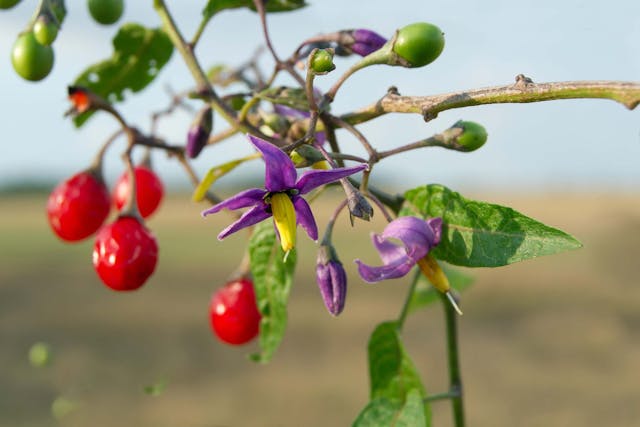
Solanum dulcamara L. [syn. Dulcamara flexuosa Moench, Solanum laxum Royle, Solanum lyratum, Solanum scandes Lamk.] - Bittersweet Nightshade
This nightshade has been identified as the “sleep-inducing strychnos” described by Dioscorides (see Strychnos nux-vomica; Schneider 1974, III: 274*). In antiquity, the root bark was taken in wine as a sleeping aid.
The Germanic peoples already used the plant as a narcotic and referred to both it and Solanum nigrum as “Nachtschaden,” meaning “night harm.” This was the name of an illness believed to be caused by an elfin demon, or nightmare spirit, during sleep, and which could be treated with Solanum dulcamara. The illness “was to be counteracted by another magically powerful elfin demon embodied in the plant; in other words, the patient’s nighttime restlessness was to be soothed by a narcotic substance” (Höfler 1990: 96*).
Bittersweet nightshade “was regarded as an elfin herb and is still known as Alpranke, or ‘nightmare-spirit vine.’ It was placed in children’s cradles to protect them from enchantment and hung around the necks of livestock against ‘Hunsch,’ or shortness of breath. People generally seem to have an aversion to this plant, calling it sow’s vine, stinking devil, dog berry, choking root, and so on. It is also regarded as a symbol of a treacherous person” (Perger 1864: 182*).
During the Middle Ages, the berries were strung on a cord and worn around the neck as an amulet or talisman against slander. The plant also featured in other magical customs: “Dried stems bearing an enemy’s name were placed outside that person’s door to initiate a revenge spell, [and] the berries could be used as a magical aid in all transformation spells, especially those involving lycanthropy, or transformation into a wolf” (Magister Botanicus 1995: 193*). It may also have been an ingredient in witches’ ointments.
In Mexico, the plant is called dulcamara or jazmincillo and is used in folk medicine as a sedative and narcotic. Solanine derivatives and tropane alkaloids have been detected in Mexican plant material (Díaz 1979: 85*).
The above-ground herbaceous parts contain 0.3 to 3.0% steroidal alkaloid glycosides, while the roots contain approximately 1.4%. The alkaloid content of the fruit decreases as it ripens. Ripe fruits are almost entirely free of alkaloids (Teuscher 1994: 737). Both the alkaloid content and its composition can vary considerably (Máthé and Máthé 1979). There may be chemically distinct variants, or chemotypes, that are psychoactive.